


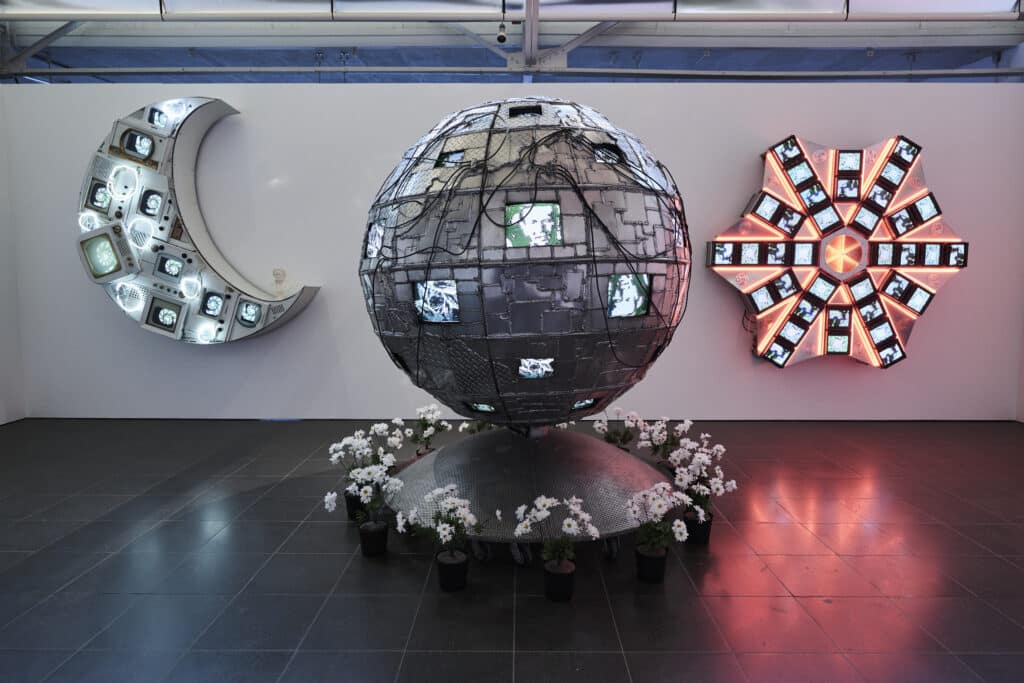
The three-part multi-monitor installation Earth, Moon, Sun (1990) by the video artist Nam June Paik (1932–2006) is one of the key works in the Aachen collection of Peter and Irene Ludwig. It impressively demonstrates how Paik, who lived in the Rhineland from 1958 to 1963, pushed ahead with the use of new technology as an art form. At the same time, it reflects his great interest in outer space, the planetary system and space flight, all crucial themes throughout his oeuvre. Acquired by Peter Ludwig in 1991 from the Düsseldorf Gallery Hans Mayer, it was the first work by the artist to enter the collection and has long occupied a prominent place in the ‘Light Tower’ of the Ludwig Forum.
Earth, Moon, Sun represents both the Ludwigs’ interest in contemporary media art, as well as Aachen’s reputation as a city of innovation, with the RWTH Aachen University at the forefront of developments in technology. Of course, media art can only be preserved through regular technical restorations, and the 81 tube televisions embedded in the sculptural elements of the work represent a serious challenge to any conservator: replacement sets are rarely available, as cathode-ray TV screens have not been produced since 2012. Furthermore, exchanging these elements for LED sets is also out of the question, due to the importance of the installed curved monitors as autonomous compositional elements within the work. Similarly, employing flat screens also makes little sense, due to their much shorter lifespan. Since July 2024, Earth, Moon, Sun has undergone an extensive restoration process: the monitors were restored in three phases by CRT-Lab Colorvac, a laboratory specialising in the conservation of CRT monitors used in video art. Christian Draheim, who runs this laboratory at the ZKM | Centre for Art and Media Karlsruhe, together with Paik’s former assistant Jochen Saueracker, have brought together media conservators dedicated to addressing this particular challenge. A technique specially developed by these two for restoring cathode-ray tubes makes it possible to continue using the original monitors, even after the end of their industrial production. Another key aspect of the restoration concerned the porous plexiglass holders used to fasten the neon tubes of the “moon.” In cooperation with the Visual Computing Institute at the RWTH Aachen University, under the direction of Leif Kobbelt, they have been reproduced with the aid of 3D printing and replaced by the museum’s conservators.
During the whole process, Earth, Moon, Sun remained accessible to visitors as an open restoration laboratory and presented the care and preservation of art works as pivotal aspects of museum’s work. In restoring the work of one of the greatest pioneers of media art, the lab demonstrated both a diversity of the technological approaches, as well as the interdisciplinary cooperation needed to conserve time-based art. Since March 2026, the work Earth, Moon, Sun is on display again in its entirety and restored at the Ludwig Forum Aachen.
The restauration of Earth, Moon, Sun was supported by the Peter and Irene Ludiwg Foundation and the Ministry of Culture and Science of North Rhine-Westphalia. Cooperation Partner: RWTH Aachen University.
Photo: Nathan Ishar